The app
A real store, not a mockup
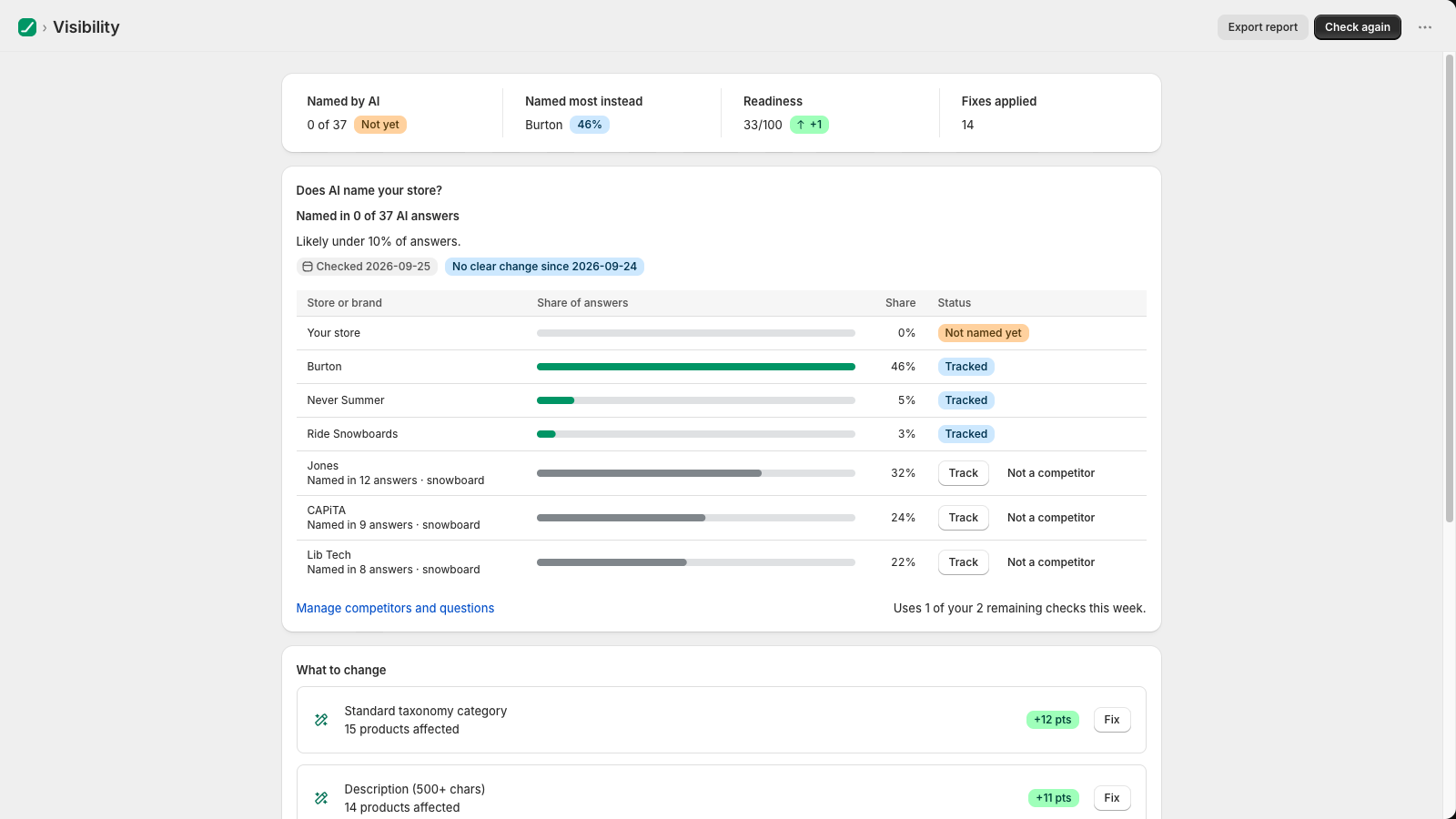
Every screen below is from a live Shopify store running FeedProof. The numbers are its real numbers — including the zero.
Shoppers ask ChatGPT, Perplexity and Shop what to buy — and get recommended by reviews, price and reputation, not just your product data. See how often AI names you and who it names instead, fix what you can, and read the difference against a set you hold back. Start with a free readiness check.
Free. Whole catalog, not one URL. Reads public Shopify data — no install, no credit card. Agencies: run it on any client store.
Ready to fix the gaps? Install FeedProof from the Shopify App Store →
Shopify puts every product in front of AI shopping agents. Whether they recommend you is a different game — and most tools measure the wrong half of it.
No way to see how often AI assistants name you versus your competitors, or whether it's moving. You're guessing.
Clean descriptions get you eligible. Recommendation turns on reviews, price, feed reach and third-party authority — the levers most "AI SEO" tools ignore.
AI orders are up 11–13× for every store — so a naive before/after always looks like a win. Without a set held back for comparison, "it worked" is a guess.
Three screens inside your Shopify admin, each answering one question. No dashboard to decode.
How often assistants reading the live web name your store for the questions shoppers ask in your category — said in plain words with its range of uncertainty, next to the rivals they name instead. Plus a readiness score on every product, and a check that your product pages are readable by agents that don't run JavaScript.
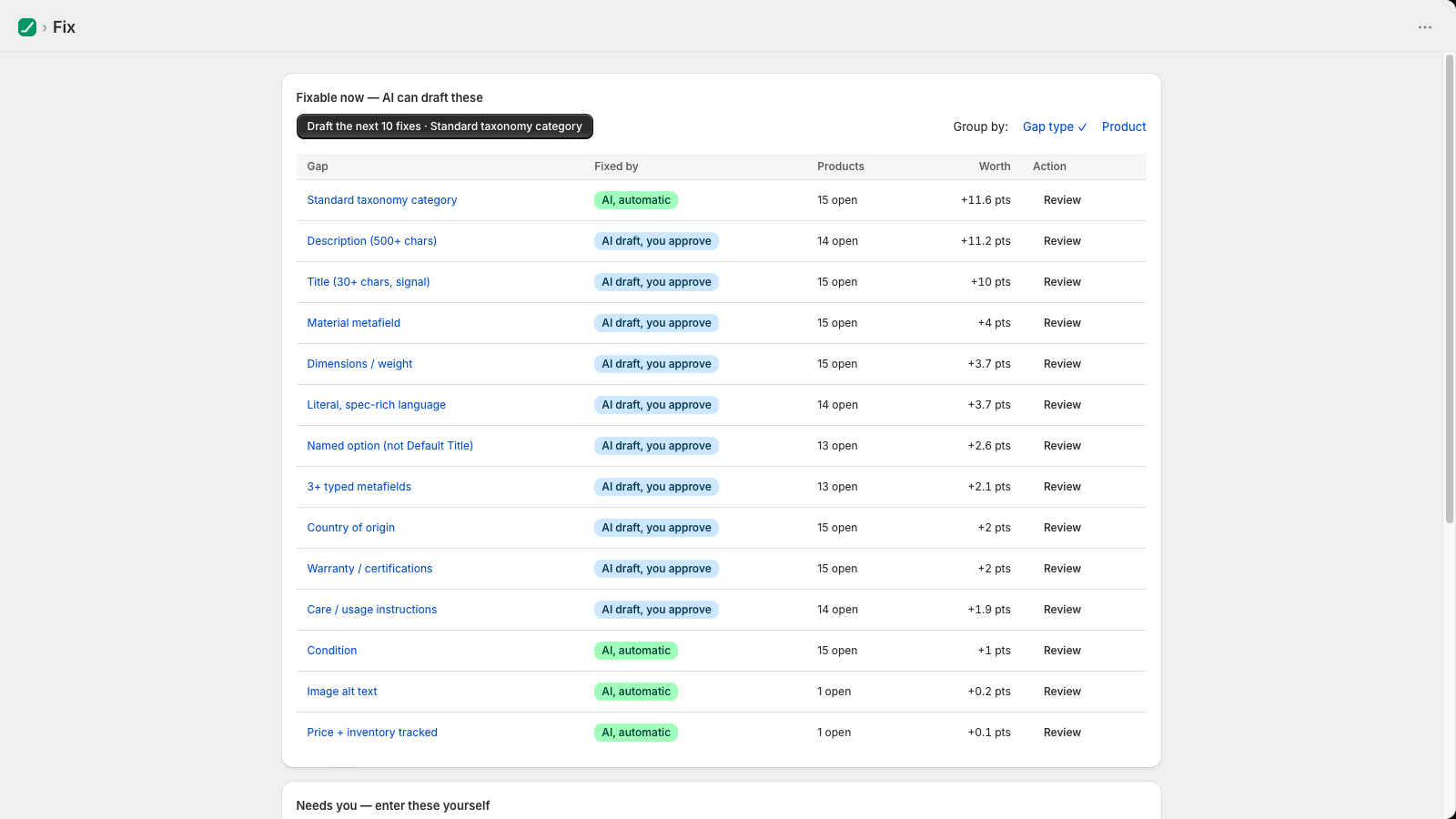
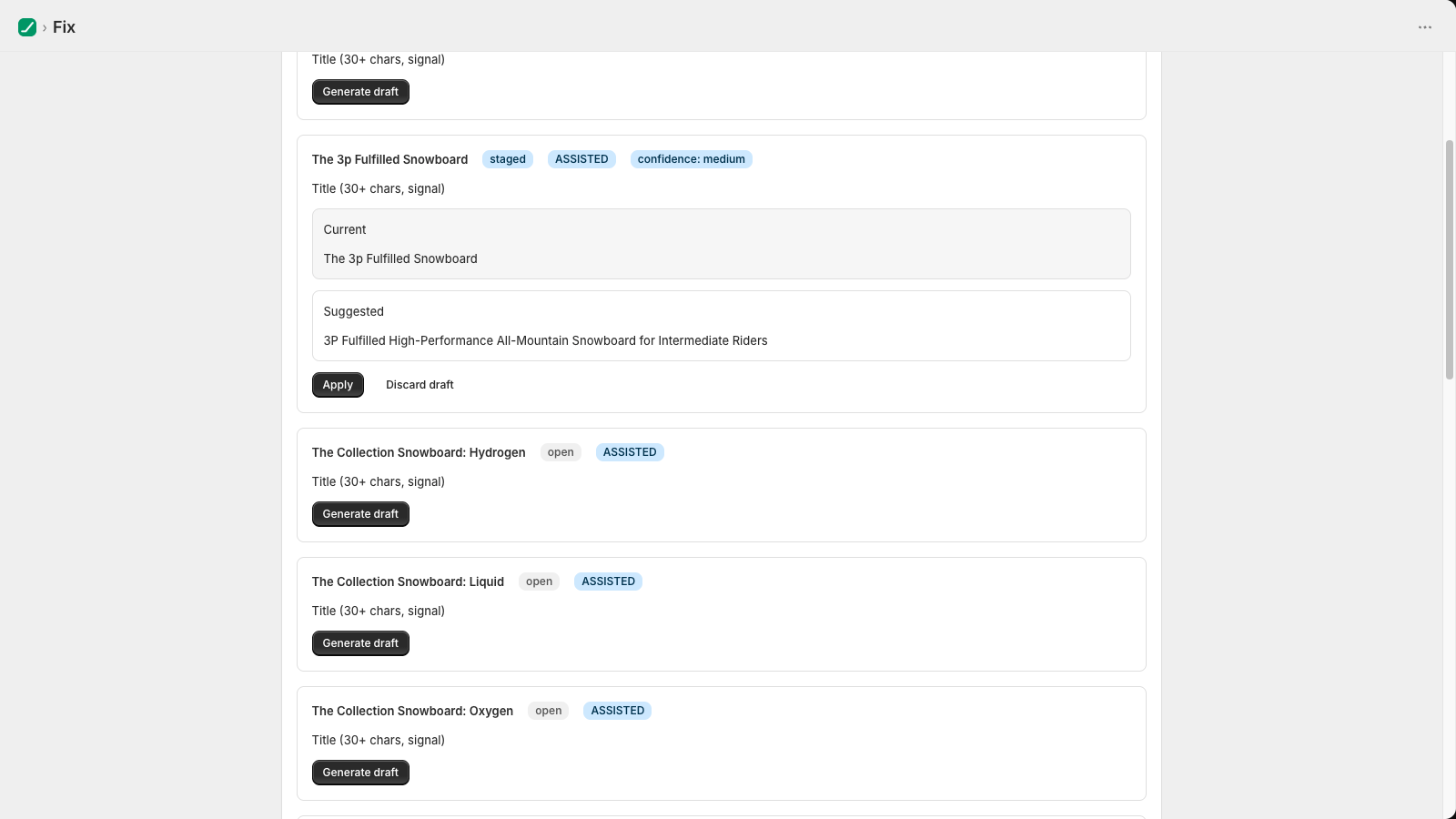
The three changes most likely to help, ranked in one list. AI drafts titles, descriptions, taxonomy and metafields; you see current versus suggested, apply in one click, revert in one click. Reviews, price and feed gaps we can't write become tasks.
A small set of products is held back unchanged, automatically. Once AI-referred orders come in, you compare fixed with held-back — the honest way to read a change when the whole channel is growing.
Every screen below is from a live Shopify store running FeedProof. The numbers are its real numbers — including the zero.
Most stores aren't named at all yet. A number on its own tells you nothing to do next, so FeedProof reads who the answers named instead and turns it into three moves.
Stated with its uncertainty ("likely under 7%"), and never called an improvement unless the difference is real.
The brands the answers named instead, pulled from the answers themselves. Track the real competitors; dismiss the rest in one click.
Catalog gaps and levers like reviews and price, ranked together — so the first thing you do is the thing most likely to help.
FeedProof is built for the agencies and data teams who do this for many stores. One console across every client — with the reporting you can bill against and defend in a QBR.
Visibility, readiness, open gaps and the hold-out comparison for every store you manage — sortable, at a glance, with per-client drill-down.
Hand each client a branded AI-visibility scorecard — comparative, confidence-bounded, and honest. The renewal story.
Fixed versus held-back products per client, with the uncertainty shown — not a naive before/after a sharp client will see straight through.
The AI-visibility space is full of tools that measure and dashboards that dazzle. We do the harder half: fix the catalog and measure the difference against a hold-out — the comparison a measure-only tool can't run. Every number shows its source and its confidence interval.
No llms.txt gimmick, no "we guarantee ChatGPT cites you." Just a comparative position against your competitors, the real levers named, and a comparison that says what it can and can't tell you.